Engineering notes
The crash that wasn't: debugging Kinjo's CI with AI
A CI-only failure, a human hunch, fast AI-assisted experiments, and diagnostic work that became part of the product.
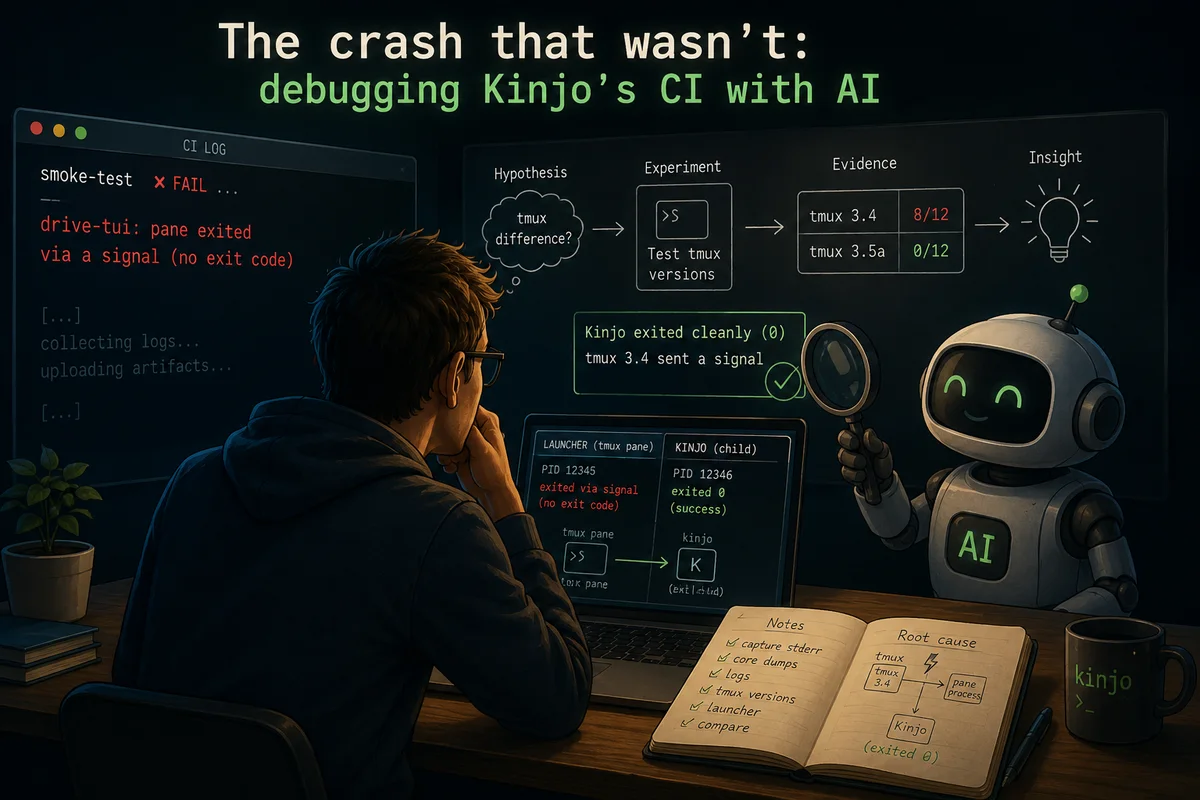
A CI smoke test told me Kinjo had crashed. Kinjo had actually exited successfully.
That distinction took a few hours, several AI sessions, a handful of discarded hypotheses, and a small crash-capture toolkit to uncover.
I was updating dependencies in Kinjo, my side project for browsing local DNS-SD and mDNS services from a terminal UI. Its CI suite includes a smoke test that starts Kinjo inside tmux, sends it some keystrokes, and checks that it quits cleanly. Intermittently, the test instead reported:
drive-tui: pane exited via a signal (no exit code)
It looked like a classic application crash. There was only one problem: I could not reproduce it locally. Not after more than 250 runs, not under AddressSanitizer, and not while restricting the machine to a single CPU core to encourage a timing failure.
This is a story about debugging a problem that only existed in CI, but it is also about what productive AI-assisted engineering actually looks like. AI made each hypothesis cheap to test. It did not supply the decisive intuition. Most importantly, the work spent investigating the false crash did not disappear: it left Kinjo with much better machinery for diagnosing the next real one.
AI made the experimental loop fast
The most useful part of working with AI was not a single brilliant answer. It was the speed of the guess-test loop.
We could form a hypothesis, change the test harness, push an experiment through CI, inspect the evidence, and move on. We captured the TUI’s stderr separately. We changed the driver to distinguish a normal exit from a signal death. We bisected dependency changes. We enabled core dumps and arranged to collect gdb backtraces, kernel messages, journal entries, and application logs after a failure.
Several of those experiments ruled things out rather than finding the cause. A suspected dependency was not responsible. Reverting other dependencies changed how often the failure appeared but did not remove it, which was a useful clue in itself: we were probably looking at a delicate timing or layout effect, not a bad code path in one particular crate.
This is where AI felt genuinely enabling. Preparing every variation by hand would have taken much longer. The machine did not eliminate the investigative work; it compressed the mechanical time between an idea and evidence about that idea.
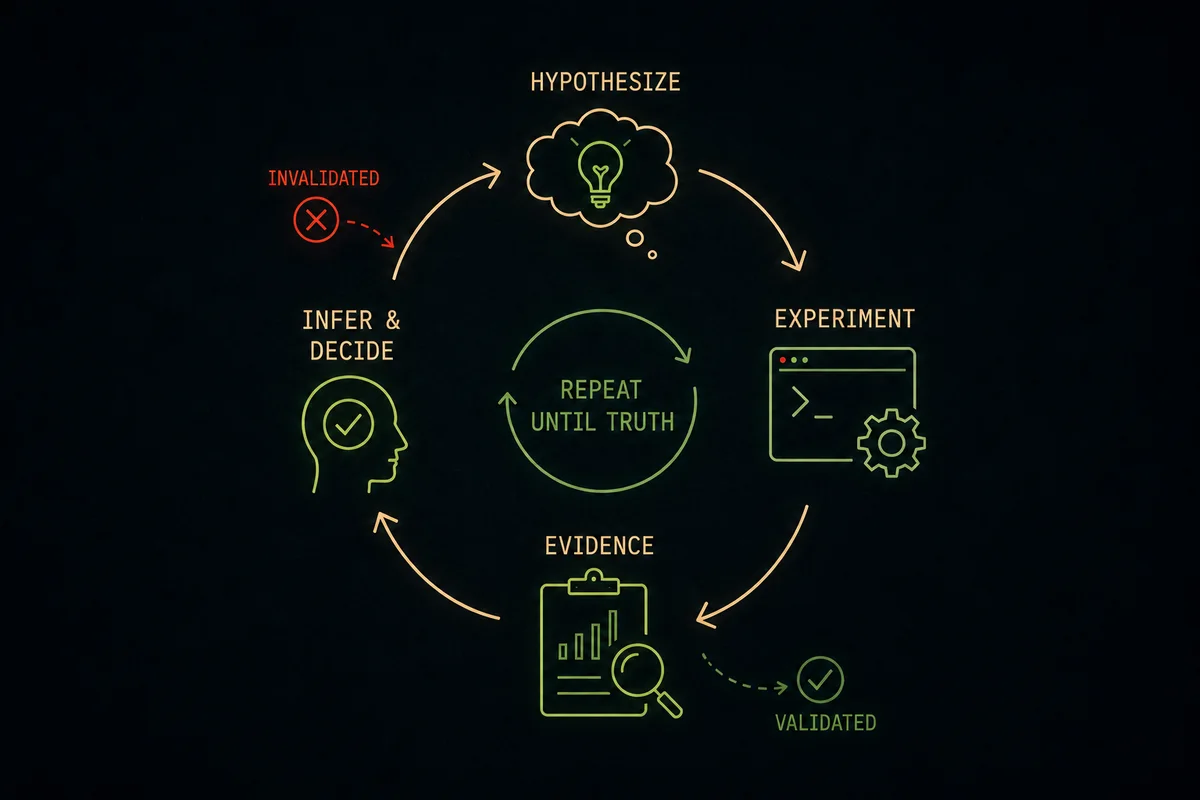
The decisive guess was a human one
Because the failure would not reproduce on my local machine, despite many attempts, I eventually wondered
whether the tmux server itself was different.
That was not a random implementation detail. The smoke test needs a real
pseudo-terminal to drive a terminal UI, and tmux is part of that environment. If
tmux behaves differently, then the test behaves differently — even when Kinjo is
the same binary.
The version check exposed exactly that difference:
- GitHub Actions was using the Ubuntu package of tmux 3.4.
- My development machine was using tmux 3.5a.
AI then helped turn the suspicion into a controlled experiment. On the same
Ubuntu 24.04 runner, we looped a narrow smoke test twelve times with each tmux
version:
| Environment | Result |
|---|---|
| tmux 3.4 from the Ubuntu package | 8 failures out of 12 runs |
| tmux 3.5a built from source | 0 failures out of 12 runs |
Same runner, same application, same test, different tmux. The failure tracked
the tmux version. That also explained why hundreds of local attempts had told me
nothing: my local environment did not contain the component that produced the
failure.
This is the balance I want to preserve when talking about AI-assisted debugging. AI was excellent at validating hypotheses and rapidly building the experiments needed to challenge them. I was still instrumental in choosing which difference to investigate. The useful unit was neither “human intuition” nor “AI output” in isolation; it was the speed with which the two could turn a hunch into a result.
The process that died was not Kinjo
Finding the version correlation explained where to look, but the most satisfying piece of evidence came from a small foreground-preserving launcher we added to the harness.
Normally, Kinjo under a smoke test is the tmux pane process. That makes the pane’s fate and the application’s fate look like the same thing. The launcher separated them. It became the pane process, started Kinjo as a child in the terminal foreground, and recorded how both processes ended.
On a failing run it recorded that the Kinjo child exited with status 0. The launcher—the tmux pane process—was the process that received a signal.
In other words, Kinjo had handled the quit command and shut down correctly! Phew.
tmux 3.4 then signalled the pane process during teardown. In the original test, where
Kinjo itself occupied that role, the signal raced its clean exit and masqueraded
as an application crash.
We never pinned down the exact signal, and at that point we did not need to. It did not produce a core dump, there was no kernel segfault or out-of-memory event, and adding more signal handling changed the timing enough to make the failure disappear. The controlled tmux-version experiment and the child exit status were enough to establish the cause.
The CI fix was straightforward: build tmux 3.5a for the smoke-test job and cache
it. The supposedly crashing test became deterministic and green.
AI debugging still has a bill
It would be easy to turn this into a story about AI making debugging effortless. That would not be honest, and just hype. The investigation was not effortless. It was still a lot of work.
The investigation consumed a non-trivial number of tokens and spanned several sessions. We maintained a handover document so that each new session inherited the hypotheses, experiments, branch state, and conclusions from the previous one. There was still waiting for CI, interpreting ambiguous results, and deciding what to try next.
But conventional debugging has a bill too. Every experiment has to be prepared, reviewed, run, and interpreted by somebody. On a commercial project those are billable engineering hours; on a side project they are evenings and attention. An engineer manually building every diagnostic variation could easily have cost more than the tokens, especially for a failure they could never reproduce on their own machine.
That does not mean token cost should be ignored. It means the comparison should be honest. The value was not that the investigation was free. The value was that AI let me run a much wider and faster sequence of experiments with the limited human time I had available. My own time.
The diagnostic work became part of the product
The best outcome is not merely that CI is green again.
To find this failure, Kinjo gained a reusable crash-capture toolkit: a launcher that distinguishes the application’s exit from its terminal wrapper, a way to enable and collect core dumps, automatic gdb backtraces, stderr capture, and a failure report that gathers the relevant system evidence without hiding the original test result.
None of that is specific to tmux 3.4. The same mechanism can be switched on for a
future CI flake, and the ideas can support user-facing bug reports when Kinjo
fails in an environment I do not control. Instead of asking someone to describe
“it crashed” from memory, the project can collect evidence that answers much
better questions: Did Kinjo receive a signal? Did it exit normally? Was there a
core dump? What did stderr contain? What did the operating system observe?
The original failure was a false accusation against the application. Chasing it made the application easier to diagnose when a real failure arrives.
A bug hunt can produce more than a fix
A CI-only failure is often described as hard to reproduce. In this case it was
impossible to reproduce locally because the relevant difference was not in
Kinjo at all; it was in the tmux server around it.
AI made this investigation practical by shortening the path from hypothesis to experiment. Human context and intuition still supplied the question that broke the case open. The process cost real time and real tokens, just as a traditional bug hunt costs real engineering hours. What made it worthwhile was both the speed of learning and what remained afterwards.
Kinjo did not have a crash. It now has a better crash-reporting mechanism.
That is a win.